Find a store

 Quote Now
From Idea to Bulk: The Complete Custom Cosmetic Packaging Process
10 March 2026



When you develop a new cosmetic line, picking the right packaging resin is one of the most critical decisions. The material affects transparency, chemical compatibility, heat resistance, drop resistance, surface finish, cost and even the shelf life of your formula.
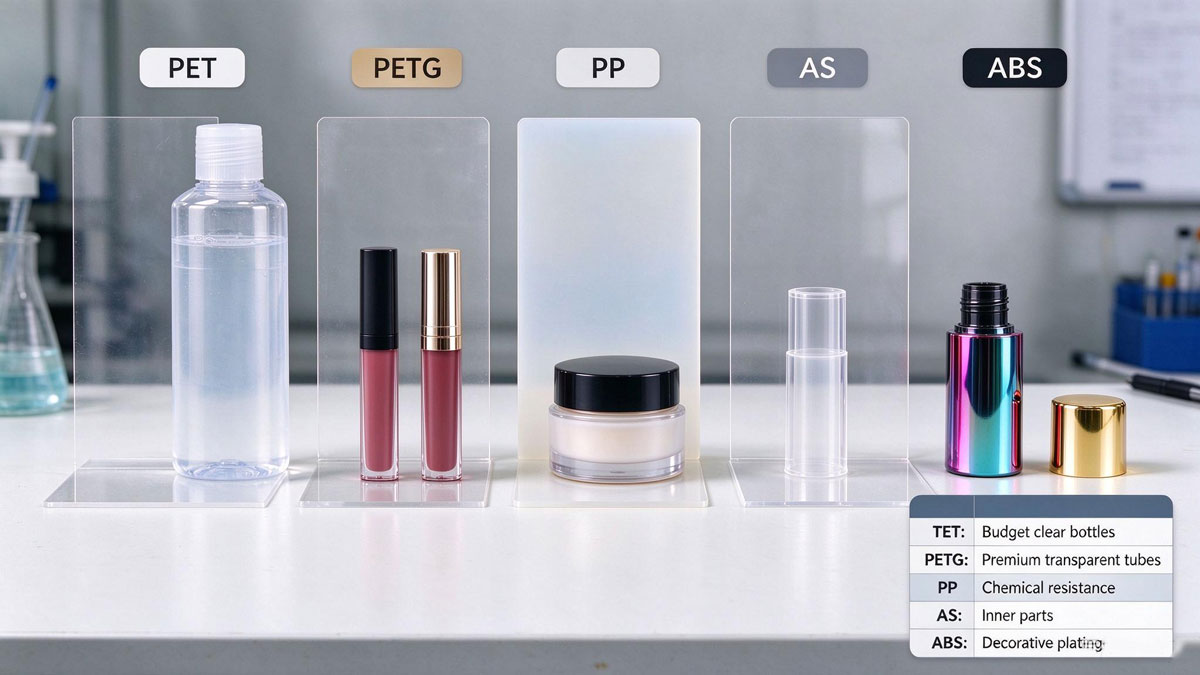
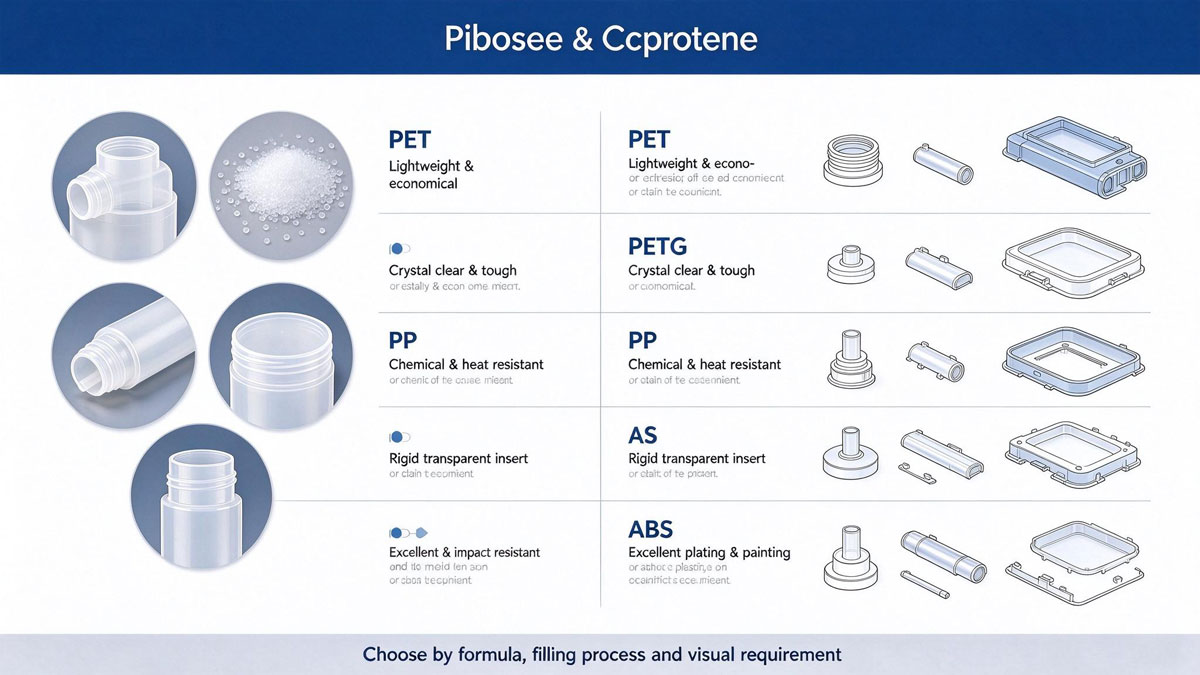
PET, PETG, PP, AS and ABS are the most common plastics we use for cosmetic bottles, tubes, caps and decorative parts. Each has its strengths and limitations. Let’s break them down clearly to help you make the best choice.
PET
PET is a widely used, cost-effective clear plastic.
Pros: Good clarity, lightweight, recyclable, economical and suitable for high-volume blow molding.
Cons: Poor resistance to high-concentration alcohol, essential oils and acids. It may crack under chemical stress. Thick-wall PET tends to turn cloudy. It deforms easily at temperatures above 60°C, so hot filling is not allowed.
Best for: Toners, plain lotions, trial-size bottles and budget transparent packaging.
Not recommended for: Perfume, high-alcohol makeup remover, acidic or essential-oil-rich formulas.
PETG
PETG is the upgraded version of PET and very popular for mid-to-high-end cosmetic packaging.
Pros: Excellent crystal clarity, no cloudiness on thick walls. Better toughness and drop resistance than PET. It works well for special curved, wavy and complex shapes. Its alcohol resistance is much better than standard PET. It supports both injection molding and blow molding.
Cons: Higher price than PET. Heat resistance is limited around 70°C. The surface is prone to scratches without protective coating.
Best for: Premium clear bottles, lip gloss tubes, sunscreen bottles, thick-wall cosmetic containers. Ideal for room-temperature filling when you want a glass-like look.
PP
PP stands out for outstanding chemical stability.
Pros: Great resistance to oils, alcohol, weak acids and alkalis. It can withstand hot filling and steam sterilization at 80–90°C. It is the standard material for airless bottles. Matte finishes are easy to achieve.
Cons: Naturally translucent or opaque; high transparency is hard to reach. Printing and plating adhesion can be tricky.
Best for: Cream jars, airless bottles, pump caps, oily formulas, essential oil products and baby skincare. Choose PP when formula safety and stability are your top priority.
AS
AS is a rigid transparent material mainly for inner components.
Pros: High hardness, glossy surface and stable injection molding performance at a moderate cost. It can be made direct contact with compatible formulas.
Cons: Very brittle. It cracks quickly when exposed to alcohol or solvents. It has a slight blue tint and poor impact resistance.
Best for: Transparent inner sleeves and decorative inserts.
Warning: Avoid AS for packaging holding high-alcohol liquids.
ABS
ABS is famous for premium decorative effects.
Pros: High rigidity, excellent plating and painting performance. It can create stunning metallic finishes and supports complicated decorative shapes.
Cons: NOT recommended for direct contact with cosmetic formulas. Poor chemical resistance and may turn yellow over time.
Best for: Outer shells, shoulder covers, cap decorations and lipstick cases. Always separate ABS decorative parts from the liquid content.
Three Key Tips to Avoid Packaging Failures
1, If your formula contains over 30% alcohol, heavy essential oils or AHAs, choose PP or PETG. Stay away from PET and AS.
2, Hot filling or sterilization requirement? PP is almost your only option.
3, If you need electroplated shiny finish: use ABS for outer decoration. If you need a transparent plated look, go for PETG.
Final Words
There is no “one perfect plastic” for all cosmetics. Your formula composition, filling process, visual design and budget will decide the right material.
If you need custom cosmetic packaging samples or have questions about material compatibility testing, feel free to contact our team. We offer fast sample production within 3 working days to validate your new product ideas.